Buy kava from Koro at Suva market, Wayne and Myra connect with family of old friend, drive to Rakiraki.
Cynthia and I wake early for two reasons: 1) So we can drive into central Suva to pick up her sulu jaba at the flea market — the seamstress says she brought it yesterday but returned home with it and forgot to bring it today so Cynthia gets a different dress — and kava at the market — sealed in plastic and pounded flat for transport. 2) So we can drive to the outskirts of Suva for Myra to look up a woman with whom she stayed when she lived in Fiji in the 70s. All we know is the address of the large settlement — acres of roads and houses — where she lives.
Miraculously, someone at a small store at the corner of a dirt road in the settlement knows exactly where the woman lives. (This may not actually be that unusual, according to Wayne. All Fijians seem to know each other. The maximum degree of separation is … three?) Although Myra’s “Fijian mum” is not there, her sixty-ish son is and he and Myra exchange all manner of information and good wishes. David sees four mongooses as he sits in the car.
When Wayne and an ecstatic Myra return to the car, we take off for the coastal road north until Myra realizes she left her sunglasses back at the settlement, giving David a chance to perform one of his patented U-turns. Gear collected, we negotiate potholes as large as the Mariana Trench and make our way along the King’s Highway on the north side of the island, heading to Rakiraki, a village of about 3,500 people.
It’s a beautiful drive and takes us a long time to cover because we are all calling out to stop the car for photos. Much of the drive is along the coast with islands offshore.
We stop at the municipality of Korovau, the center of the island’s dairy industry, to take on provisions for lunch: fruit (guava, passion fruit, pineapple, banana), chips, a plate and a knife to cut the fruit. David watches a well-dressed group of four — two mothers and two barefoot kids — finish their lunch under a tree in a park and leave their trash littering the ground.
We motor on to Uru Falls, a small cascade just off the highway, where two steep paths swarming with mosquitos dip down a hillside to a pool under the falls. A roofed porch with two tables overlooks the falls and we have lunch while two kids younger than 10 hang on the porch railing and shyly … slyly … circle our stay. Eventually, Cynthia gives them a can of peanuts so we don’t feel so awkward eating in front of kids who are not eating. As we prepare to leave, a man appears and says he is collecting the $2 Fijian each for the visit to the site and use of the lunch spot. There is a sign to this effect but no one was there when we arrived. But, word spreads quickly enough in Fiji. It is not necessary to keep anyone posted.
Our next destination is the Naiserelagi Catholic Mission. Sitting high on a hill the church has a mural of a black Christ. Christ wears a tapa/mask/bark-cloth sulu and there is a tanoa at his feet. A Fijian is presenting tabua (whale’s tooth) and Indo-Fijians are presenting flowers. We go inside for a look and then meet a man who is visiting. We noticed that the colors were pale and asked if that was true to the original 1962 painting. He tells us that the hurricane 3 years ago destroyed part of the roof and the water washed the mural. The family of the painter, Jean Charlot, have come recently to repair it and to replace broken stained glass windows. He tells us that the painter was a friend of the 1960’s priest and was asked to paint the mural. It is lovely and a wonderful break to our road trip.
Onward we go to the Tanoa Rakiraki hotel, which has signs all over that it’s having its 50th birthday. We unload our gear and decide to go to the Volivoli resort to see the sunset, have drinks and dinner. It’s about six klicks distant on a peninsula that forms one prong of a large bay that the sun is going to sink into pretty quick. We arrive at the Volivoli resort and walk up to the two photogenic Fijians at reception who ask us what we would like. We say, “A gorgeous sunset, a few drinks and a delicious dinner.”
They look incredibly sad and say, “We are so sorry but the dining room is fully booked for dinner tonight. There are 58 guests in the hotel.”. After the past three nights of rained-out sunsets in Suva, we are NOT to be denied so we ask if we might have drinks while we watch the sunset from the cabana and then we’ll go, please?
They speak to one another, make a phone call and tell us that they have booked us for dinner at another resort nearby but we may have a drink by the beach and watch the sunset here. OK we say and practically run down the long curving cement walk to the beach below where we are greeted by Nick and Steve, the owners of the place who immediately say we’re welcome to stay for the singing and dancing and bonfire and kava ceremonies as well as the cocktails and canapés and dinner if we wouldn’t mind sitting at the table on the sand over there?
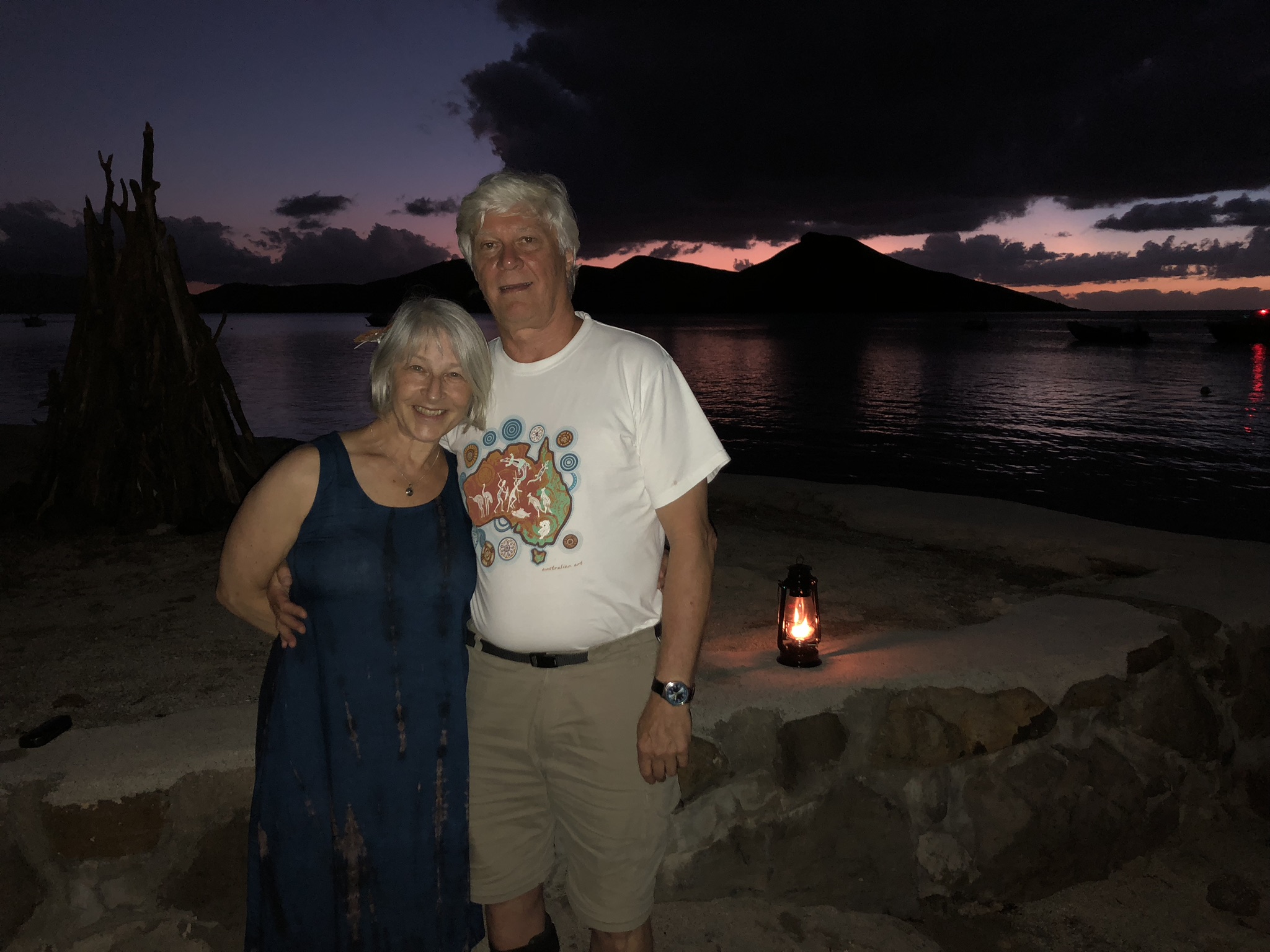
Myra and Cynthia order hurricanes, Wayne gets a beer and David dives into a Margarita as the sun sinks into the ocean at the edge of the world, turning the sky and clouds from a white-hot point to copper to glowing embers radiating heat and peace across dead calm waters. The 58 members of the Syracuse, New York, dive group filter onto the beach as waiters and waitresses prepare the buffet tables laden with food from a traditional Fijian lovo (food cooked in a pit in the ground under leaves), the evening grows darker and the lanterns are lit all around.
We get more beer, some wine … the dancers dance the fan dance and the spear dance and the singers sing songs that end with the traditional farewell of Isa Lei as the bonfire’s flames soar into the dark sky and the owner’s two pre-teen girls weave in and out of the dancers and we are told to start the line for food, which we eat as a fellow on a guitar starts singing softly in the distance.
Wayne and Myra and Cynthia join the kava circle ceremony — clap your hands twice when someone gets a bowl-full and gulps it down — and Wayne is finally living his Fiji moment, back in the elements he loved long ago: lying on a mat, shooting the breeze with music and a mild narcotic coursing through the evening, finally arrived at the place he seeks.
Life in Paradise is good