The sun! The Sun! THE SUN!!! And an azure sky arcing above the world as far as we can see. A passable breakfast in the hotel and we venture forth for our guided tour of Portugal’s oldest university, founded in Lisbon in 1290 by King Dinis, but moved to Coimbra in 1537 by King Joao III. A muuuuch longer climb to a meeting point that turns out to be the wrong place but is guarded by a person who sends us to the right place just as David realizes he forgot his camera, which pretends it’s a phone or a phonograph. Tant pis pour moi.

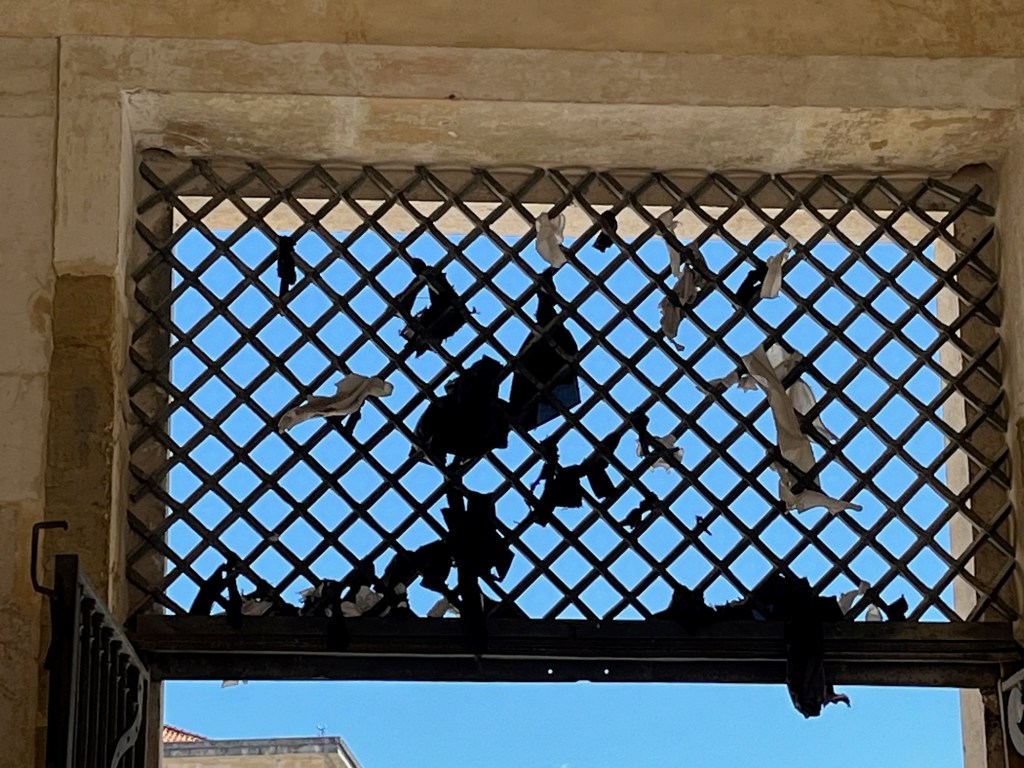
We get to the right place and are gathered with four from Toronto and others by Daniel who leads our small group to the “Iron Gate” entrance to the university’s law school where graduates urged by their exuberant friends strip, climb, and attach their clothing to the iron trellis across the top of the gate’s arch, descending naked and happy and … graduated. Daniel shows us video evidence of this barristerly behavior.
He also walks us through the royal palace — one of the three sides of the enormous plaza, which houses classrooms and cafeterias and lots of students overjoyed they will graduate and, perhaps, get briefly naked in about six weeks — which was the kings’ residence in the 12th and 13th and 14th centuries, so still adorned in places with majestic spaces and portraits of royalty and the trappings of divine right. And he takes us into King John V’s library built in 11 years between 1717-1728. Baroque and beautiful, constructed with jacaranda and other exotic woods and more gold leaf than there is bitcoin today. Hidden study rooms, ladders secreted between stacks of the 300,000 ancient volumes on the two floors of shelves accessed by staircases also accessed through panels that look like decoration.

After the tour, Cynthia finds a faculty lounge for lunch and David dashes back to the hotel to get his camera and returns to his beloved, who is by then on her second glass of afternoon wine. We walk through a few more of the university buildings, awed by the Science Building’s Cabinet Room of Curiosities, which has more than 5,000 objects with not a single explanatory sign or notation. Some very strange stuff … definitely not Kansas anymore but definitely Oz for the curious.
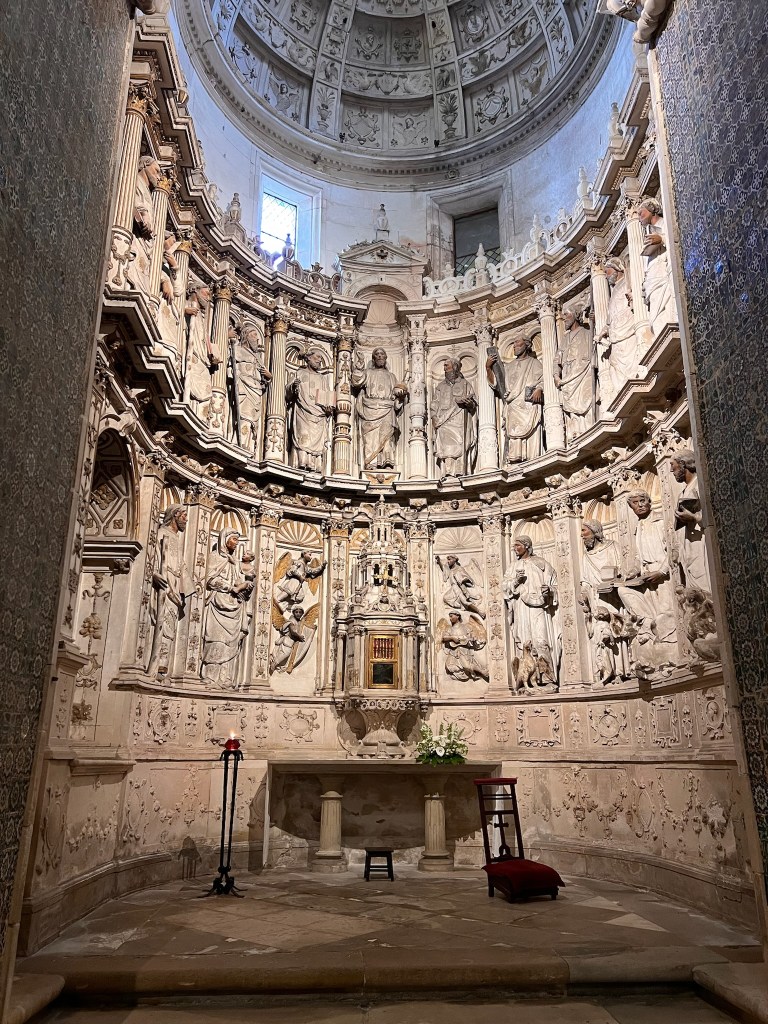
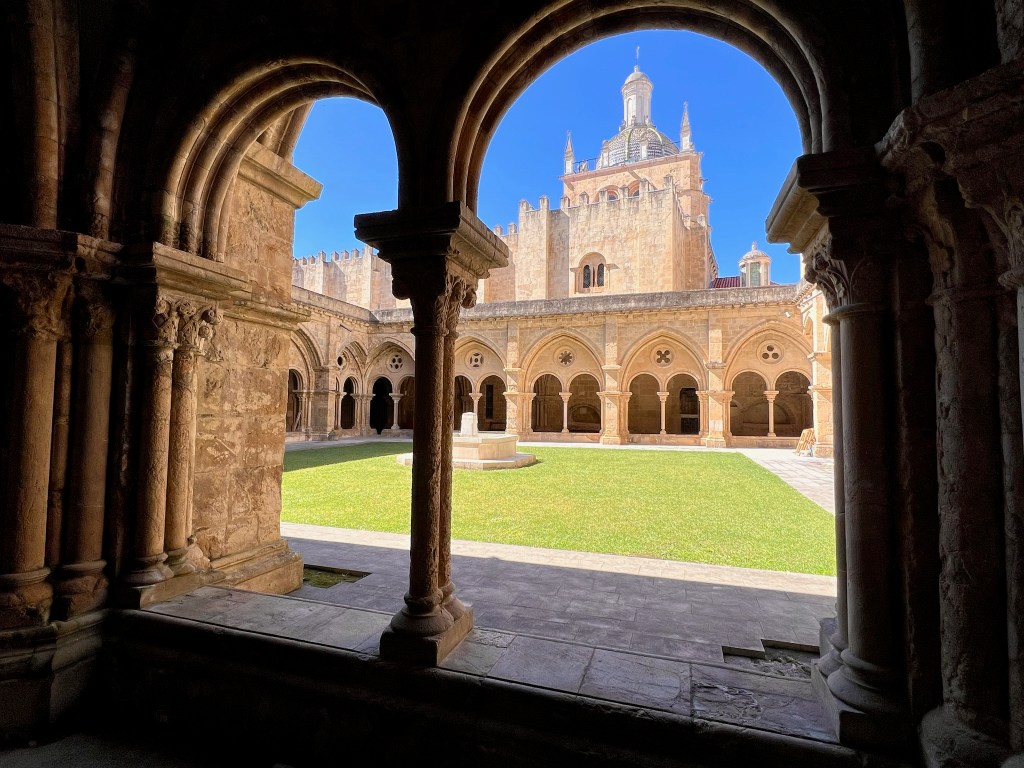
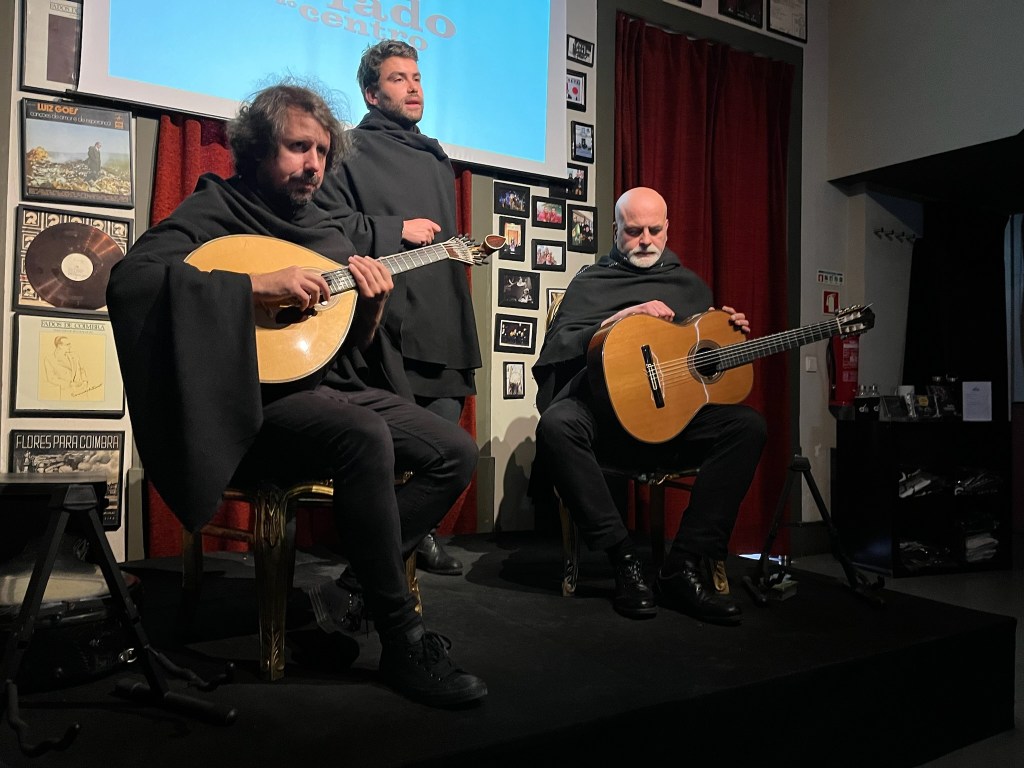
We traipse down the hill, gawk inside the old cathedral and its lovely, intimate cloister and side chapels with 10 apostles carved in 1566 beside the main, “Flaming Gothic” alter built of gilded polychrome wood. We emerge and have a nice G&T beside the bronze lady across from our Fado place. We get a brief history of fado, a few instrumental pieces — the Portuguese guitar player frets faster than the eye can see — a few sung pieces in a few different styles ranging from classical to contemporary, love ballads to protest songs — and sip a complimentary glass of tawny port when the show ends after an hour at about 7 PM.
Though we had dinner reservations somewhere “typical,” Cynthia has discovered a place that opens at 8, takes only 20 eaters at a sitting from a standing room only line outside its front door in a three-foot-wide alley, and specializes in bones: goat, pig, cow: vertebrae, ribs, secret sauces, earthen pitchers of house wine (yes … Hemingwine), and a jovial backslapping, the-world-is-my-oyster-kinda vaudevillian fellow joking with his countermen and patrons the whole time we were there. A trim version of Oliver Hardy.
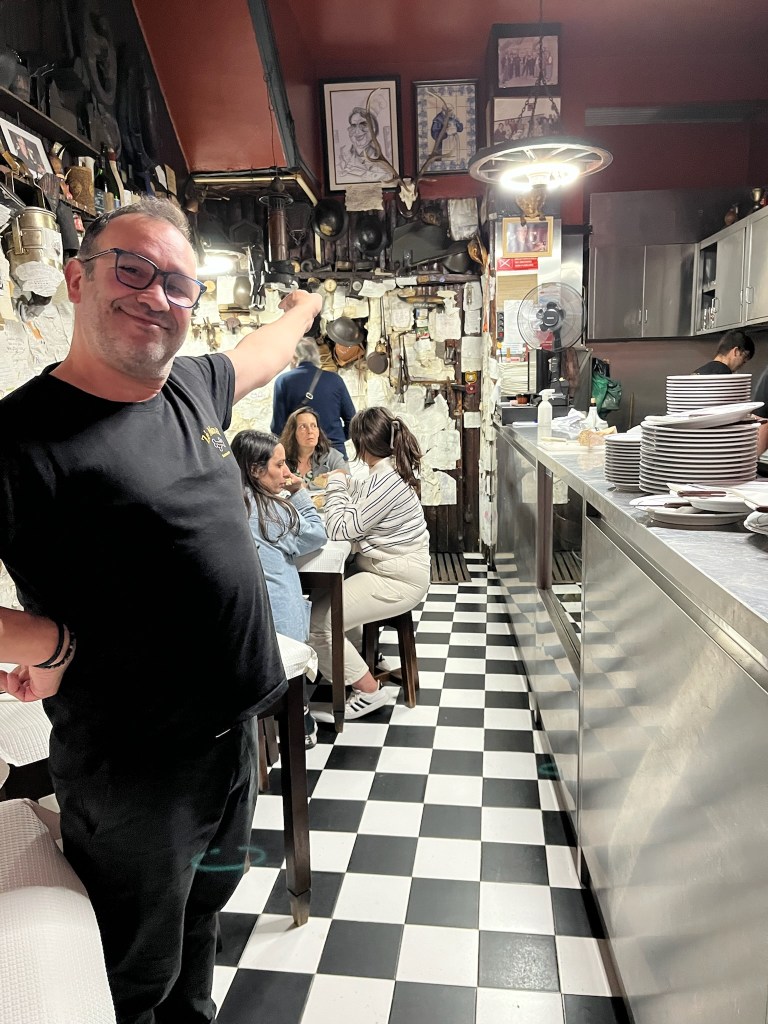
Yes, people were waiting in the alley to get in when we left, stuffed and sated for 32 euro. Stanley Tucci would call his time at Ze Manel dos Ossos a “Big Night.”
Indeed, at least another great day with sites to feast the eyes and ears and minds, and a big night to boot.
And not a drop of rain.
 Two Tramps