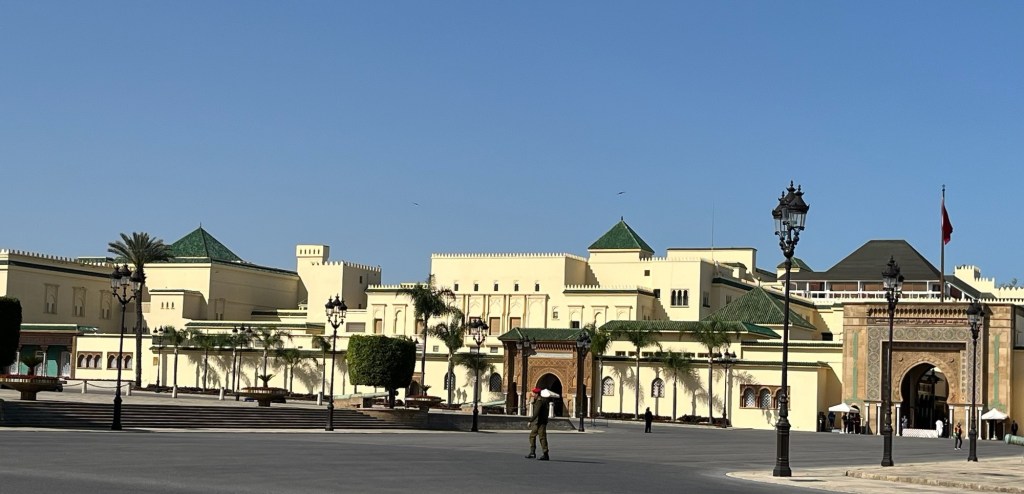
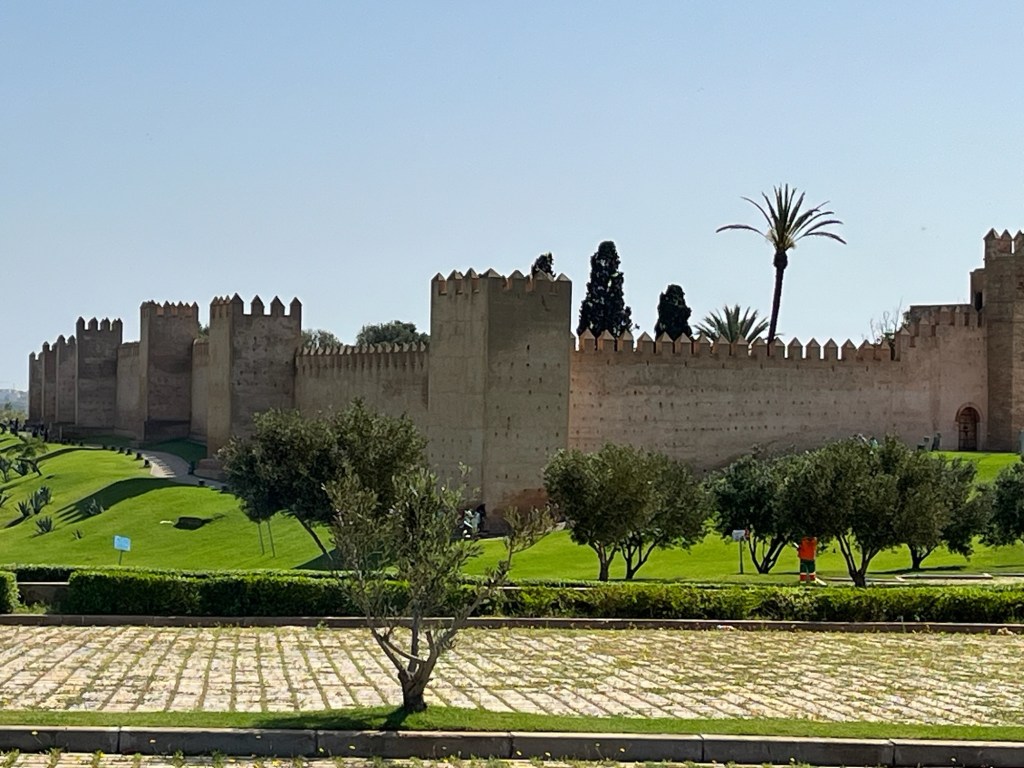
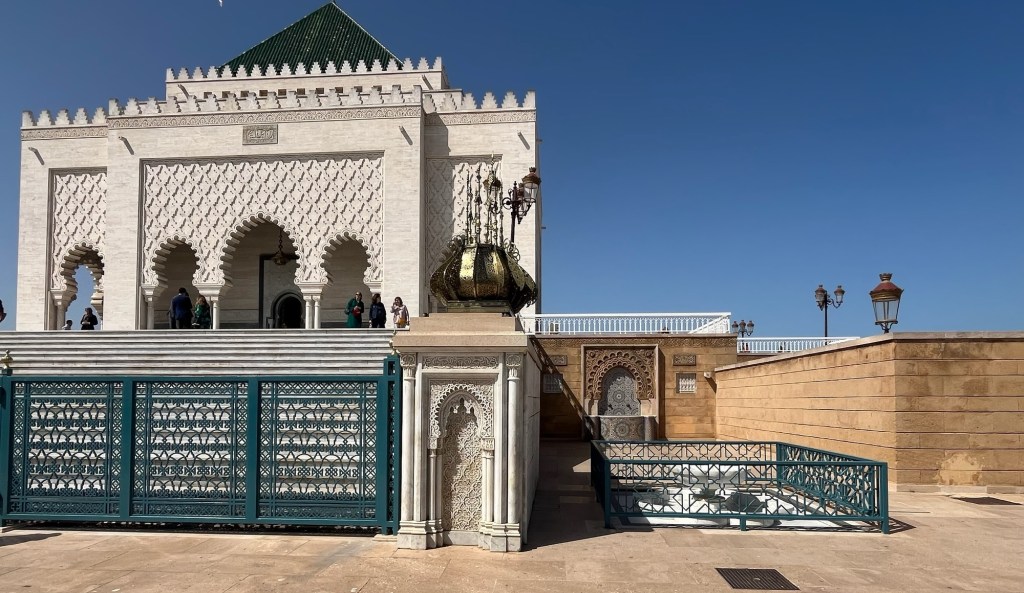
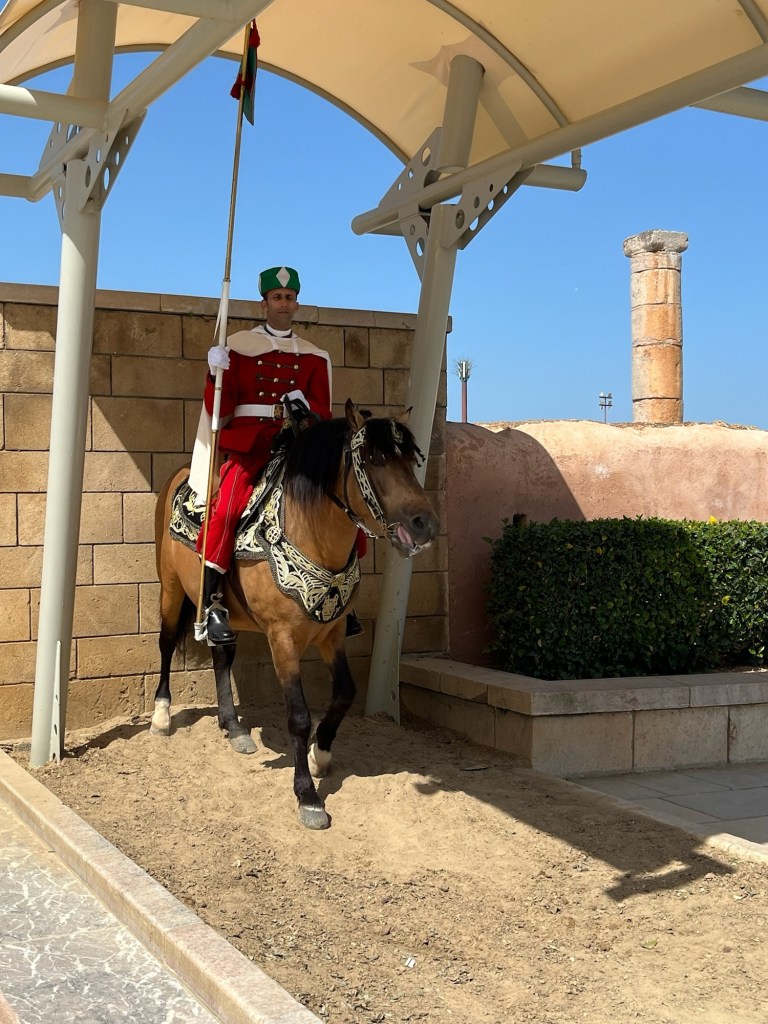
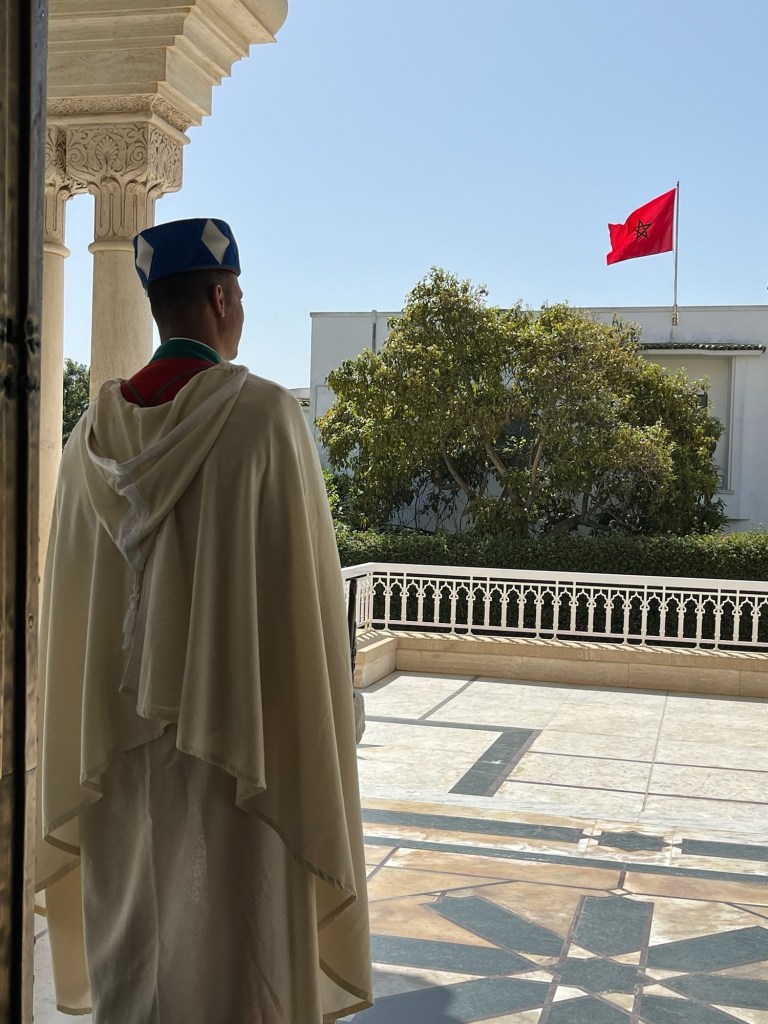
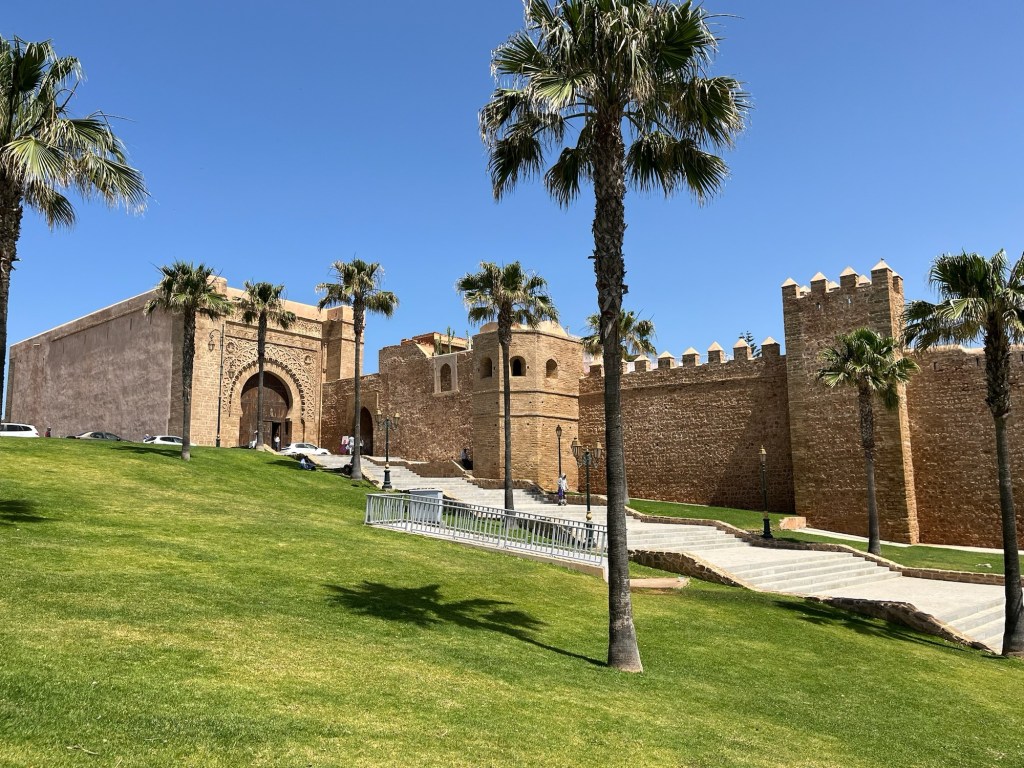
After breakfast in our hotel, we’re back on the bus, which takes us first to the king’s administrative palace — huge grounds, single buildings that stretch farther than you can see, lovely manicured gardens, and guards of several services in different uniforms — then back on the bus to see the Chellah (think “fort) with the red-clad dancing drummer outside the main entrance (we cannot go in because it’s still under renovation) — then back on the bus to the mausoleum of King Mohammad V (in a very tony neighborhood overlooking the river and next to a mosque that was Morocco’s largest until it burned to the ground, leaving only a plaza of stone columns next to the 11th century Hassan tower — then back on the bus to have a looooong (IMHO) lunch at the Dar Shan Riad in the medina.
After lunch we waddle back to the CCCL for a performance of four pieces, some sung, of Andalusian music done in the style of a fellow named Ziryab, whose music broke with his mentor’s musical sensibility and Arabian music’s traditions in about 830 AD. Arabian music then, apparently, had such strong religious roots that deviation from tradition was near heresy to the point where Ziryab split Baghdad (I think, not sure …) for Cordoba, Spain, where he developed a non-polyphonic oeuvre with long, constantly embellished pieces. Think “Elvis is in the House.”
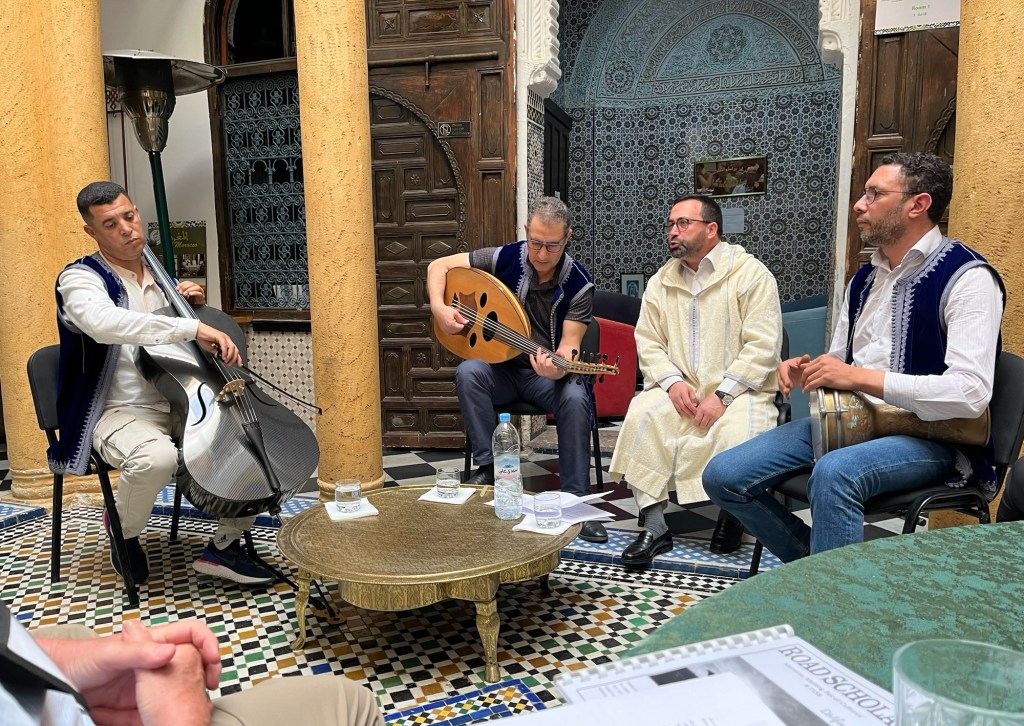
We are asked to read English translations of the songs … think poems, really … that will be played by the Andalusiyyat Al-Assili group of three musicians — oud, cello and tabla — and one male singer. Members of our group volunteer some nice readings and the band begins. One instrumental and the rest songs. Good stuff. Different. Sinuous: loooooong riffs with subtle variations along the way.
We take a break after which we’re treated to a lecture on “Contemporary Moroccan Politics” by a dapper author, professor, and foundation founder named Abdelhay Moudden. Here’s a Cliff Notes version that does not do justice to the numerous facts and complexities he imparts:
Morocco is a monarchy that does not consider itself ever to have been colonized except during the Protectorate (1912-1956). The current King, Mohammed VI, is the 24th Alawite Dynasty ruler (founded in 1630s) and is called the “Commander of the Faithful.” The faithful includes EVERYONE: Muslims, Christians, Jews, Sufis, you name it. This inclusiveness is evidenced when the king will not permit Moroccan jews to be exported to Vichy France or Germany in WWII. The king also agrees with de Gaulle, Churchill and Roosevelt at the 1943 Casablanca Conference to supply troops — including the feared Berber goumiers from the Atlas Mountains — for the allied effort.

Meanwhile, King Mohammed VI continues to work with resistance (to the Protectorate) fighters and the Moroccan free press, advocating the end of the Protectorate, giving a significant speech at the Souk de Barra (just down from the Cafe de Paris) in Tangiers’ French quarter. The frogs do NOT like this and exile the king and family in 1953 to Madagascar, where they stay for 27 months, returning home in November 1955.
Bang! The Protectorate ends in 1956 and Morocco more or less returns to a monarchy that pleases most of its citizens and the rest of the world. Times are pretty good: cities expand, the economy grows, the population increases and becomes increasingly urban. The “usual” stresses of a developing nation with a strong religious bent erupt on May 16, 2003, when impoverished youths encouraged by Wahabi mentors blow up a hotel and nearby buildings in Casablanca. Shocks the hell out of everybody. Result: The Commander convened a commission and the country’s Moudawana, its “Family Law,” was revised, most notably, expanding women’s rights
Life goes on until the 2011 Arab Spring, which gives students and disaffected others a chance to protest. The Commander of the Faithful convenes another commission, basically, to make some political, economic, and cultural (I think “religious”) changes. The commission complies and suggests “amendments,” which the king and Parliament effect — all laws, we are told, are secular — to make what the king calls “a new constitution.”
One of the changes, however, is that the party in Parliament with the most seats gets to appoint the Prime Minister who, within a few years and after a somewhat surprising election, is a (my words here) die-hard Islamist. This lasts until 2021 when, surprisingly, the die-hard lose fairly big time and Parliament reverts to playing musical chairs with several parties — the RNI, National Assembly of Independents (“liberals” in the sense of free-market zealots), and the RJD, Party of Justice and Development (moderate Islamists who recognize the legitimacy of the king) — dancing delicately around each other. But the king takes advantage of the changing Prime Minister and Parliamentary make-up to convene yet another commission to suggest changes suitable for the changing society’s political, economic, cultural and religious practices and laws.
The lecture ends and we descend a flight to the CCCL’s dining room for a lovely dinner of vegetable soup followed by Tfaya, a couscous with lamb, raisins and carmelized onions, followed by dessert … as always, way too much food so we waddle through the medina back to the bus, which takes us to our hotel, where we, along with everyone else in Morocco, go to sleep wondering what recommendations this latest commission will give the king.
 Two Tramps