Frank and Kathleen left wonderful French roast beans for our coffee and we figure out the appliances easily enough that we have a nice “breaky” with the pastries we brought from Ciuidad Mexico. While waiting for the french press to steep, we climb to the roof to check out the condominium that parrots have built in a tree about 15 feet distant; it’s one of three in a grove of trees and about 12-15 feet tall and 5 feet wide with dozens of little green parrots flitting and squawking about.
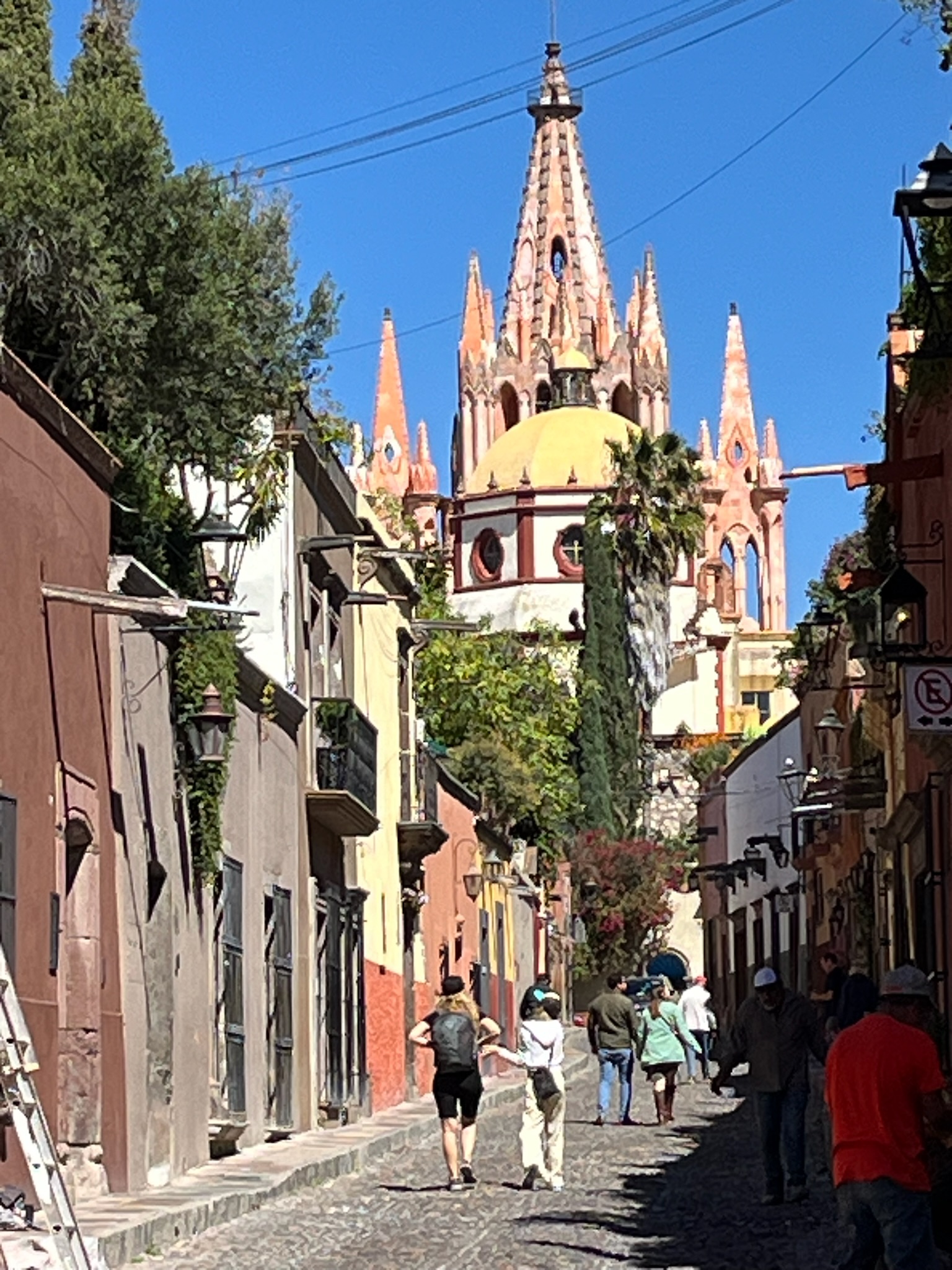
Debra knows the town well enough after a dozen annual “vay-cays” that she takes us on her personal guided tour of the main parts of town. We walk on surprisingly straight cobbled streets, a few with old trees in them, hopping onto narrow sidewalks to avoid the slow-moving cars bumping everywhere. Compared to Ciuidad Mexico, this is a small town, more intimate and colorful with numerous doorways shrouded in Bougainville. We walk through the Colonia Aldea section of the city, south of the central square, heading toward the Parochia (church and, though large, NOT a cathedral).

A “Cliff’s Notes” digression to set stage and explain the town’s name: Franciscan friar Juan de Miguel — whence the “Miguel” comes — set up a Catholic outpost near here in 1542. When silver was discovered in nearby Guanajuato in 1557, sleepy San Miguel became an important stop on the Silver Road, which stretched from Mexico City to Santa Fe, New Mexico. Time passes and Ignacio Allende, who later dies fighting for independence from the Spanish, is born in 1779 in San Miguel, which adds his name to its own in 1826 to commemorate his role in the 1810 uprising that ended Spanish rule. As silver fortunes decline in the late 19th century, San Miguel goes back to sleep until 1926 when the Mexican government declares the town a national monument and a Peruvian diplomat-in-exile, Felipe Cassio del Pomar, falls in love with the quality of the city’s light that he founds the Escuela Universitaria de Bellas Artes in 1937. (You cannot make up this kind of history …) For reasons that elude me, the United States puts this institute on the GI Bill after WWII, and SMA quickly burnishes its “expat-artist” cred, adding art schools and galleries as fast as you can say, “Great climate, cheap living, nice locals, life in the slow lane, let’s do lunch.”

We cruise the Instituto de Allende, founded in 1950 by Stirling Dickenson, Enrique Fernandez and Mrs. Nell Harris to give degrees in art. Like almost all places artsy in Mexico, it has a mammoth mural populated with a lot of people we don’t recognize without a scorecard.
We walk north toward “centro,” the central square in front of the Parroquia de San Miguel Arcangel, whose neo-gothic pink sandstone facade’s design was drawn in the sand each morning in 1880 by local stonemason Zeferino Gutierrez because none of the workers could read. Legend has it that he drew it based on postcards he had seen of European cathedrals.
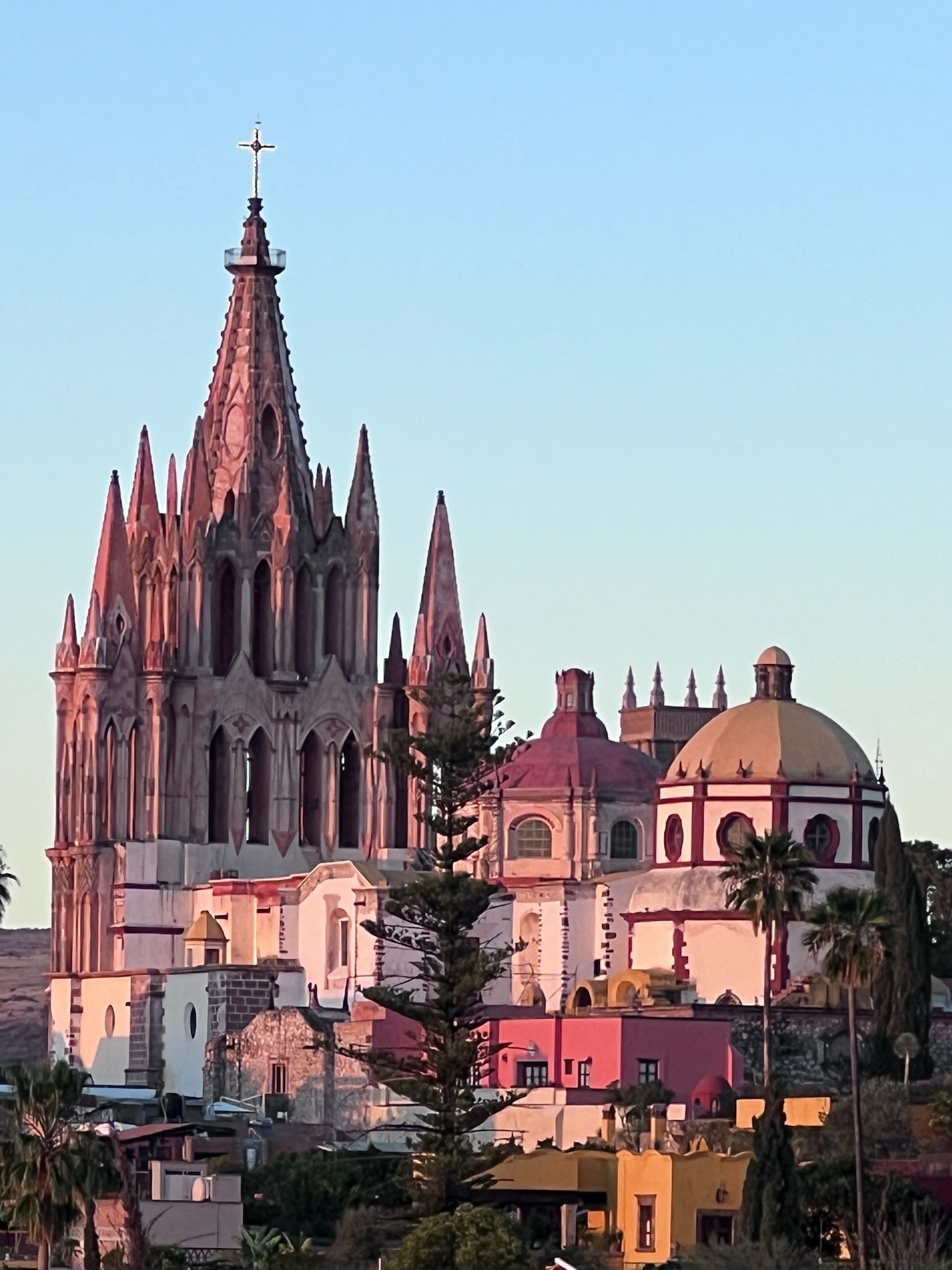
We skirt the square and Debra points out the first gas pump in SMA, now essentially an outdoor sculpture, and we wend our way past thrillions of boutiques selling trillions of hats and clouds of colorful clothing and billions of meso-tchotchkes to glaze-eyed throngs of inquisitive tourists sporting favorite-band t-shirts, ponytails, and wives who seem blissed to realize every block has at least two hidden courtyard cafes with shaded tables and artisan sweets on each side of the street. And at least one small dog lounging on its master’s shoulder in the hidden cafe the girls find for lunch.
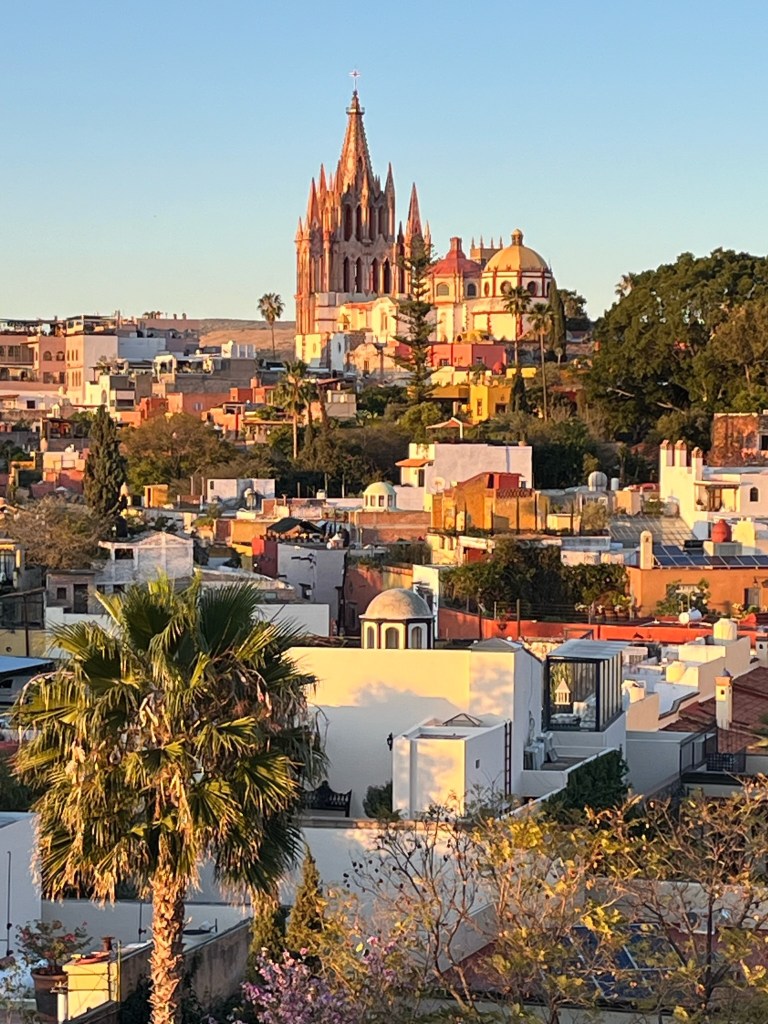
After lunch, we continue to hunt for hats, tablecloths, napkin rings, blouses, earrings, and the heart of Monday afternoon until we repair to the roof bar of the Rosewood Hotel, whose concierge acknowledges our reservations and leads us to … I am not kidding … the best table and chairs in the house, right on the northwest corner that overlooks all of San Miguel AND the sun setting over the western mountain range in the far distance. Every tourist on the roof needs to stand in front of us to have their photo op in front of the Parroquia up the hill or beneath the setting sun. We mostly smile and drink our pretty good drinks.

We have a rotisserie chicken dinner with vegetables we soaked in deadly chemicals and a nice white wine we found in a large local wine store that also sold us a couple four-packs of fever tree for our G&Ts.
And that’s the way it was on Monday. G’night.
 Two Tramps