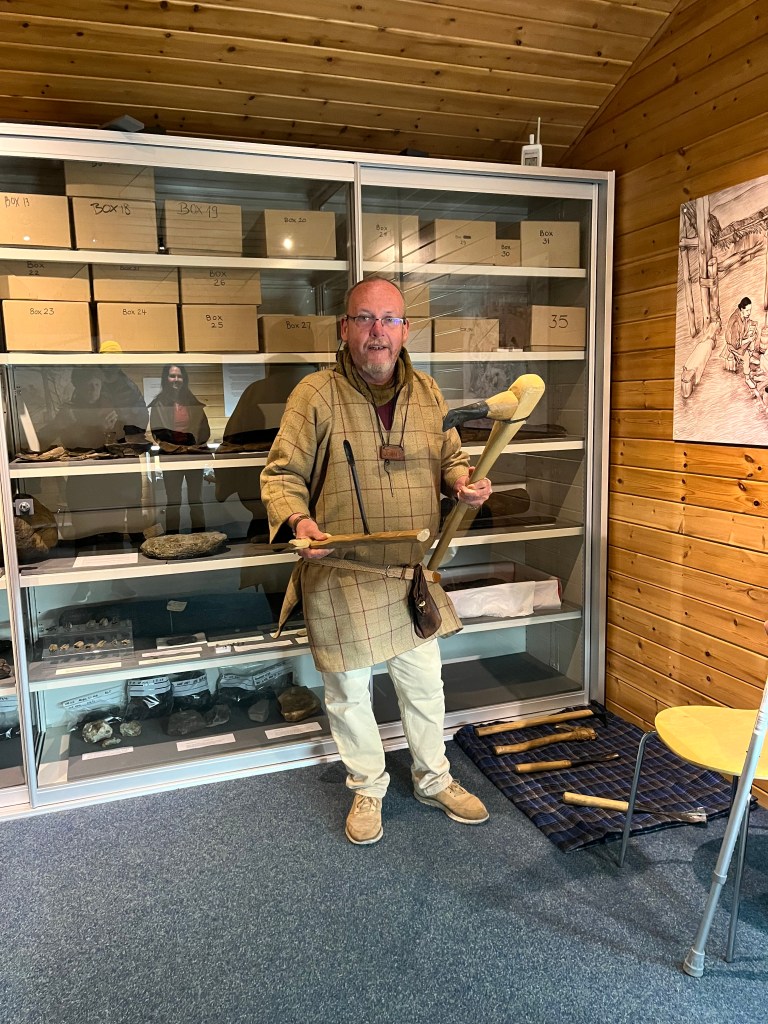
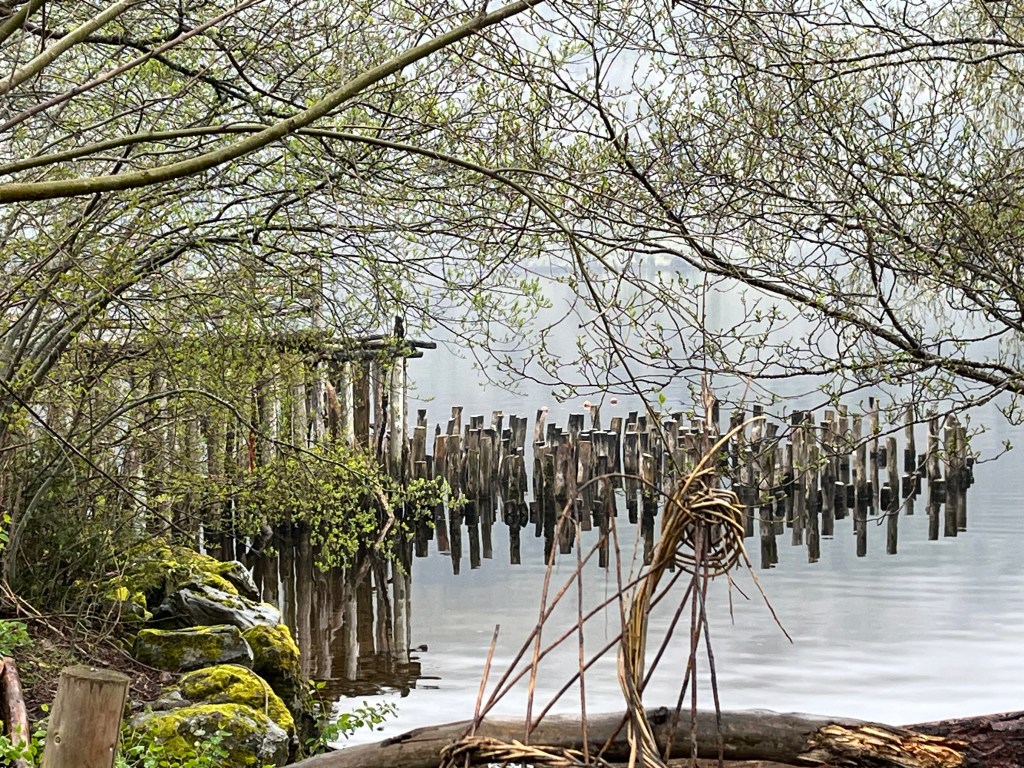
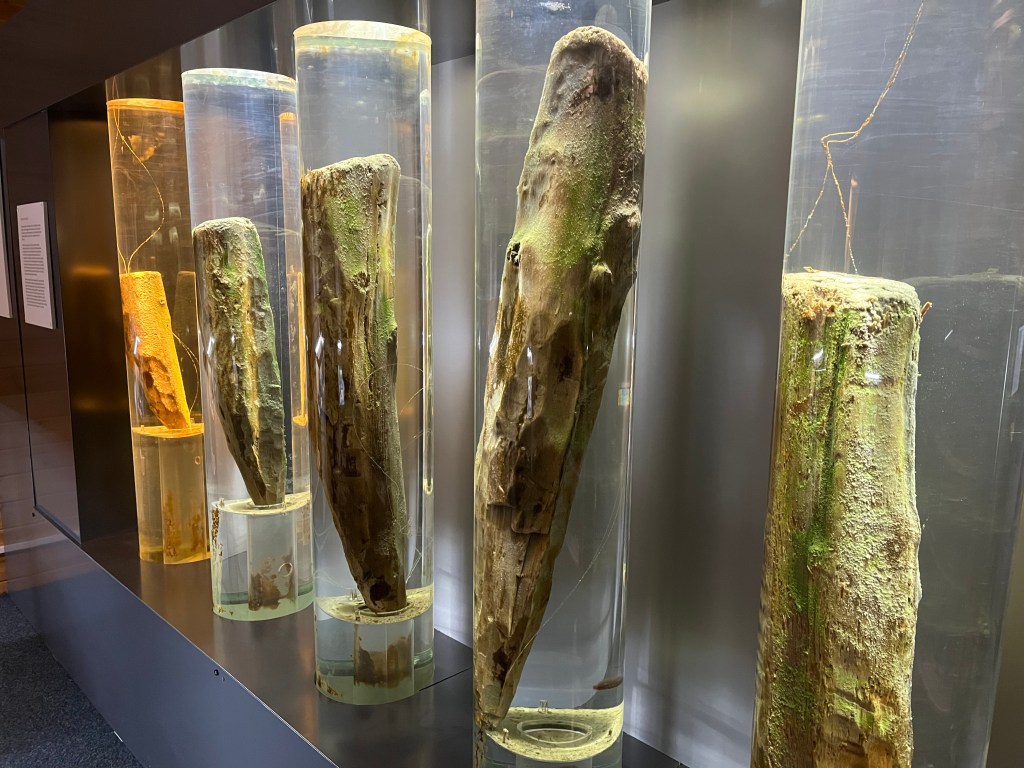

The better planner wants to learn how civilization began in wet and craggy Scotland, so we bung our bags into the Mazda again and head south an hour-plus in steady drizzle to the Scottish Crannog Centre on a bank of Loch Tay to learn how late bronze-age/early iron-age Scots lived. A crannog is a round house built on stilts driven into a lakebed, with tree trunks for walls, clay, peat and branches for a floor, and a conical roof of whatever was available. The one at the centre burned up two years ago. (Crannogs elsewhere – England, Ireland, etc. – were not necessarily wooden but all were artificial islands on water.)
We get a lively tour of artifacts and history in a small museum and, outdoors in a light rain, demonstrations of carpentry (primitive wood lathe), pot-making (roll clay into a ball and push your thumb into it), weaving (spinning, dying, looming), and cooking.

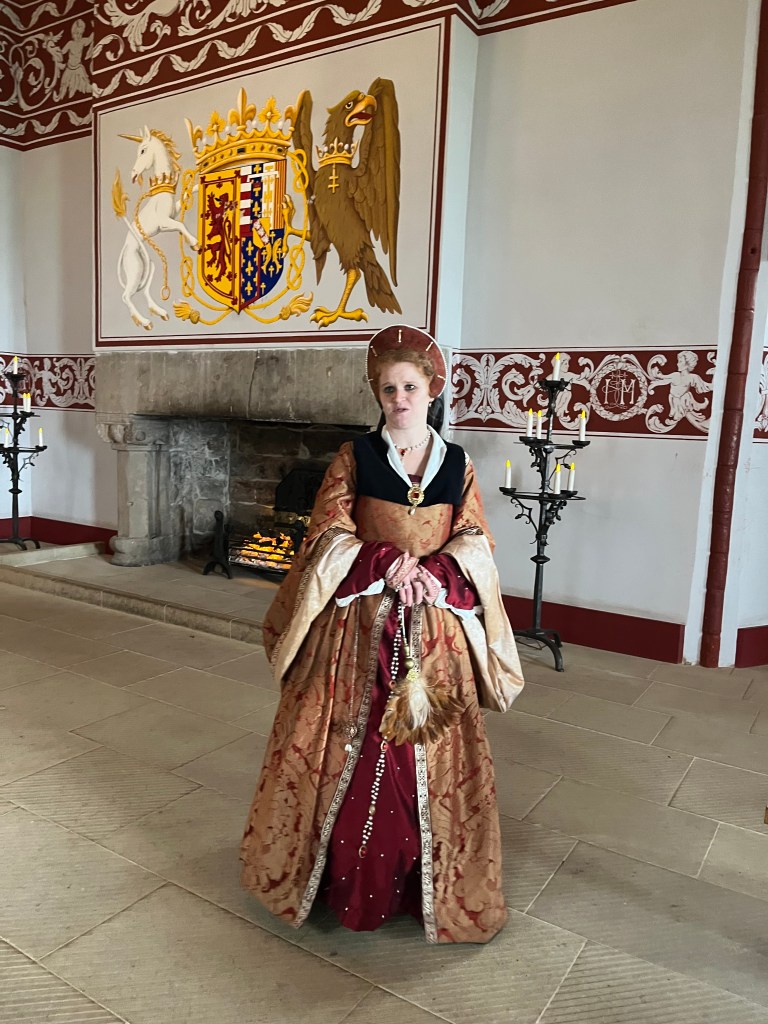
Onward to Stirling Castle, site of many battles in the Scottish Wars for Independence (including the 1314 Battle of Bannochburn when heavily armed English forces mired in a nearby swamp were decimated by Robert the Bruce’s fleet followers). It remains in the royal hands of the House of Stewart – a couple Roberts, scads of Jameses, and a few Charles – for about the next 300 years (Queen Mary was crowned there in 1542), after which, it became a garrison for a while. It’s huge and has many large parts destroyed, rebuilt, repurposed, and restored by a variety of inhabitants over centuries of time.
Our guide, Patrick, who grew up under the castle’s walls, is delighted to tell us its history and does so endlessly in the rain, merely pointing to open doors – “don’t miss the tapestries inside those royal apartments,” “make sure you see the inside of that chapel,” “the actors in period dress in the rooms above that door are terrific sources of information” – as water drips from our umbrellas and hoods.
The drive from Stirling to Edinburgh is surprisingly easy and Ross, the host of our B&B sends us to an Indian restaurant called Haldi (turmeric) a block away. The food is delicious, and we chat with Robert Kyle and Alyse Korn, two musicians who live and play and tour together.
We return to 23 Mayfield Gardens guest house and Cynthia chills in our room while David raids the honour-system bar in the library for some Jura whiskey stored in rum casks, and watches some of the early silent black-and-white movies in constant rotation on a TV above the fireplace. Stan and Oliver were really funny.
And bed.
 Two Tramps