

Suva walk, rest at GPH, visit Peace Corps headquarters.
We have a quick continental breakfast on the veranda of the occasionally Netherlands Consulate overlooking mostly trees but, also, the distant harbor and surf breaking on the coral reefs offshore. We drive downtown and park next to a row of 15 stalls with wizened old guys sitting in front, selling wooden tanoa (big, round, shallow wood bowls that hold kava (mildly narcotic root that’s ground, mixed with water and given to people sitting in a circle around it to drink from a cut coconut shell, which David thinks tastes like a gritty dram of mud slurry), battle axes (hardly ever used even back in the 1820s), wooden forks shaped like a squid with tentacles for tines, and various other conceptually-authentic-but-mass-produced-for-tourist drek.
Suva is decidedly third world, as was Nadi. The amount of litter, especially candy wrappers, styrofoam food trays and crumpled plastic bottles of every soda you might name, is depressing. The crumbling infrastructure likewise. Neither Wayne nor Cynthia recognize the city’s particulars: old stores are gone, new highways are slung across sluggish brown rivers, even the numbers of people mobbing the streets are beyond their memories.
Wayne and Myra go their way to hunt for lost time and t-shirts while David follows Cynthia through the maze of fruits, spices, vegetables and odds and ends in the central market. The colors and smells of spices are overwhelming. After she locates a place to buy kava from Koro, the island where she was a volunteer, to bring back to DC (saving a bundle; a kilo of “the good stuff” is only about Fiji $85 here (2 to 1)), we wend our way to the Flea Market so she can get a sulu dress to wear to the next biennial gala back in the U.S., back in the U.S., back in the U.S.S…. She finds one but the nice Indian woman suggests that Cynthia’s hips are a skosh large for the skirt and would she like to return tomorrow after it’s been altered.
She would and we go on a walk about town, following a tour suggested by Lonely Planet that takes us to St. Andrews wood church high on a hill and down the hill to the edge of the national rugby field(Albert Park) and Thurston Park next door, which houses the national museum.
The museum has some interesting stuff: the last wagga drina (large, ocean-going canoe) built by craftsmen who possessed the 18th-century concepts and skills to make one. It was made in Vulaga in 1913 with a main hull 13.43 meters long and a domadoma (mast) 7.92 meters high. Prows of the main hull made from a single tree trunk and the outrigger hull are decorated with white cowry shells. Around the museum walls are various cases with information about Feejee’s cultural and economic history.
Example: The first major trade commodity lasted a short period of time, only 10 years from 1804 to 1814. It also has a sad bit of history that begins in January 1800 when the American schooner Argo — not Ben Affleck’s rescue of Americans from the Canadian embassy in Iran — sailing from China, wrecked on Bukatatanoa Reef. Its survivors brought “lilabulavu” — an undefined epidemic, but probably measles — that eventually reduced Fiji’s population from 250,000 in 1800 to 85,000 in 1921. That said, Oliver Slater, one of the survivors recognized sandalwood in Bau Bay on Vanua Levu (Big Place) and parlayed this information to the Chinese when he was rescued and taken there around 1803. The fragrant trees were wiped out ricky tick.
The next — and last? — of the island group’s major trade commodities was beche de mere, considered a delicacy by the Chinese, which fetched uppity prices in Manila from about 1820 to 1860.
Notable among this delicacy’s exporters was Captain John H. Eaglestone, sailing out of Salem, Massachusetts, who cut deals with local chiefs for labor. He had a “batterhouse” (curing shed) around 1840 that employed more than 100 men daily to cut firewood in the surrounding forest to feed the fires under the cauldrons used to cook the gutted sea cucumbers before they were dried, bagged and shipped to the Philippines. The chief supplied more than 1,000 divers daily to bring in the slugs.
Finally, besides a variety of whale’s teeth, tapa cloth, and other exhibits, we gawk at the remnants of HMS Bounty’s rudder, raised from Bounty Bay off Pitcairn Island in 1932. It’s a bit shredded because it was stored in the post office at Pitcairn for many years and visitors would tear off small chunks to take home as souvenirs.
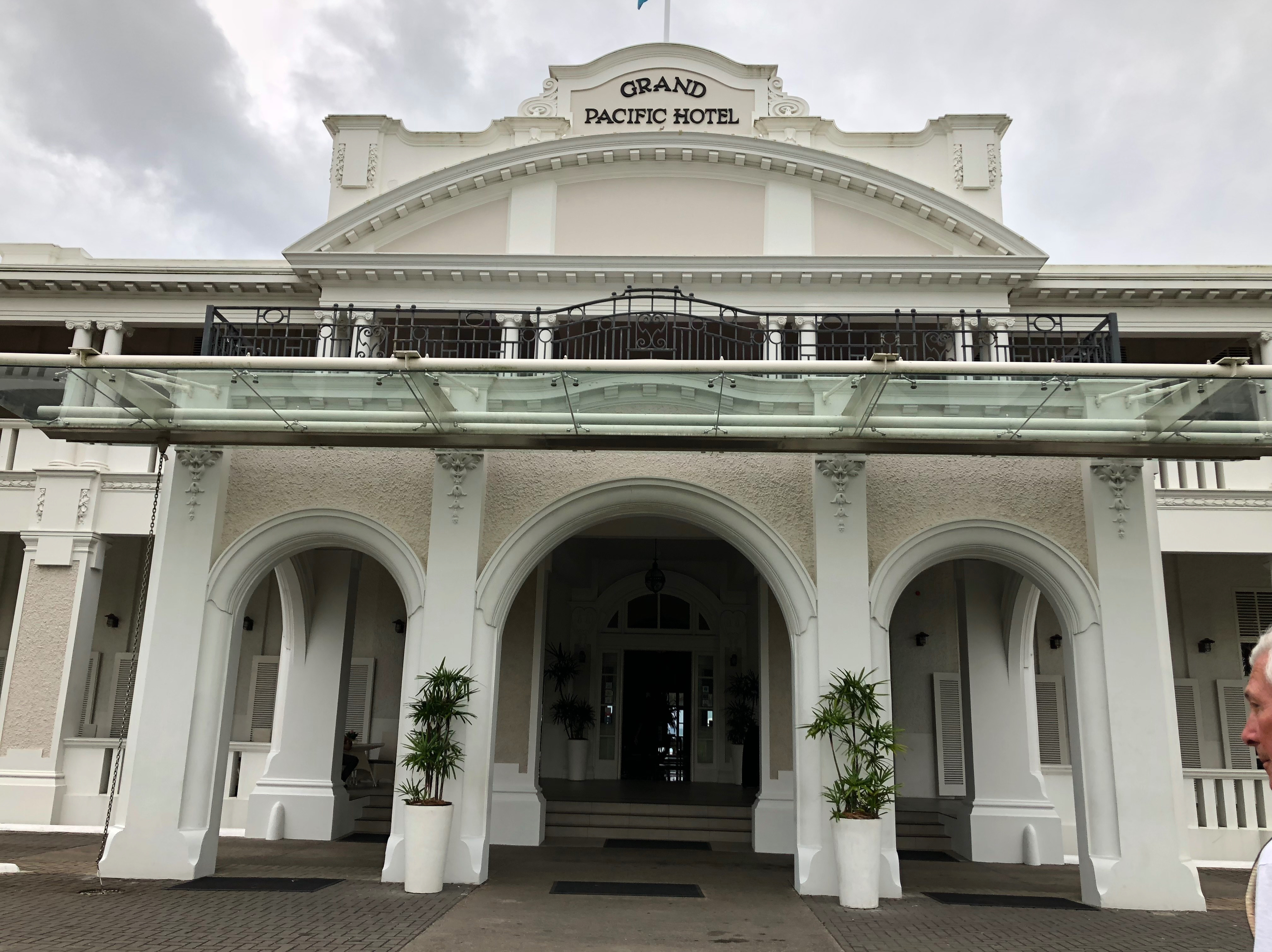
We walk over to the the Grand Pacific Hotel, which is white and grand and looks across the wide Pacific bay that is Suva’s harbor, and order up some Fiji Coladas and other cocktails to sustain our afternoon drive up, down and around — No, we are not in New Zealand — Suva’s many hills, remembering things past and finding the present in the person of Peace Corps Fiji’s current director, Dennis McMahon, in his office on top of one of the hills. He invites us in and we chat for a while and repair to the Fiji Yacht Club for dinner with expats, few natives in sight. Slightly awkward-feeling and a touch depressing but we were tired of curry and the restaurant served great burgers.
We return in a downpour to our digs where we have nightcaps on the veranda. An American couple join us for a while. They have both had careers in hospitality and traveled extensively.
Another disillusioning day in Paradise.
 Two Tramps