


Queens Road from Nadi to Suva with interesting stop in Sigatoka for lunch and old Tongan fort.
We load bags into the trunk of our VW Polo and tool out of Nadi under sunny skies, heading south for Suva. Our first stop is down a random street off the main highway about an hour out of Nadi. The street winds through a very small ocean-side village, which we refrain from photographing because we feel a bit like intruders. But we want to get to the ocean to see the surf breaking off the coral reefs that ring the island so we motor out of the village and backtrack a bit to another road that turns out to be an access road to a resort that is under construction on the beach.
The beach, like many in Fiji, is not a fine sand but is a rugged lava rock stretch covered in large chunks of coral that have not been around for long enough to have been broken down into sand (or existed in the water long enough to have been consumed and defecated by squadrons of parrot fish. We hunt for shells and watch fishermen standing in the surf inside the reef about 1,500 feet from shore.
We say goodbye to the workmen dumping sand into the foundations of the Chinese resort-to-be and motor down the highway to Sigatoka, where we take our obligatory three wrong turns before crossing a bridge over the Sigatoka River — longest but second-largest in Fiji, and home to mussels being collected by several groups of mostly women — on our way to see the Tavuni Hill fort.
Around 1850, Tongan chief Maile Latamai left Tonga to avoid a disputed with the reigning Tui Pelehaki family. Maile left with an entourage of spokesmen, priests, warriors, carpenters, craftsmen and fishermen. He stopped at some islands on the way to Fiji, but for unclear reasons had to split kinda quick, leaving behind a few of his fishermen but taking the rest of his entourage to a place called Korotogo. There, he put his carpenters to work but thought the house they built for him was so deficient that he kicked down the walls and left. And finally arrived at the hill top of Tavuni where he built a fortress of wood and stone that eventually was destroyed during the Keilolo wars in 1876.
We are led up a hill from the fort’s parking lot by a guide and her assistant, a high schooler. They show us the foundations of huts — small round stones overgrown with grass in oval and rectangular mounds under trees — grave sites for the chiefs’ women — “It’s ok to walk on them but not on the chiefs’ graves when we get to them — and a killing stone — the place where vanquished warriors were beheaded before being eaten. The Sigatoka River, wide and slow, sweeps in a wide meander below.
The head chief’s grave has a cross on it because he was, surprisingly for a cannibal, a Christian. (This is at cargo cult level if you ask David, but no one does.)
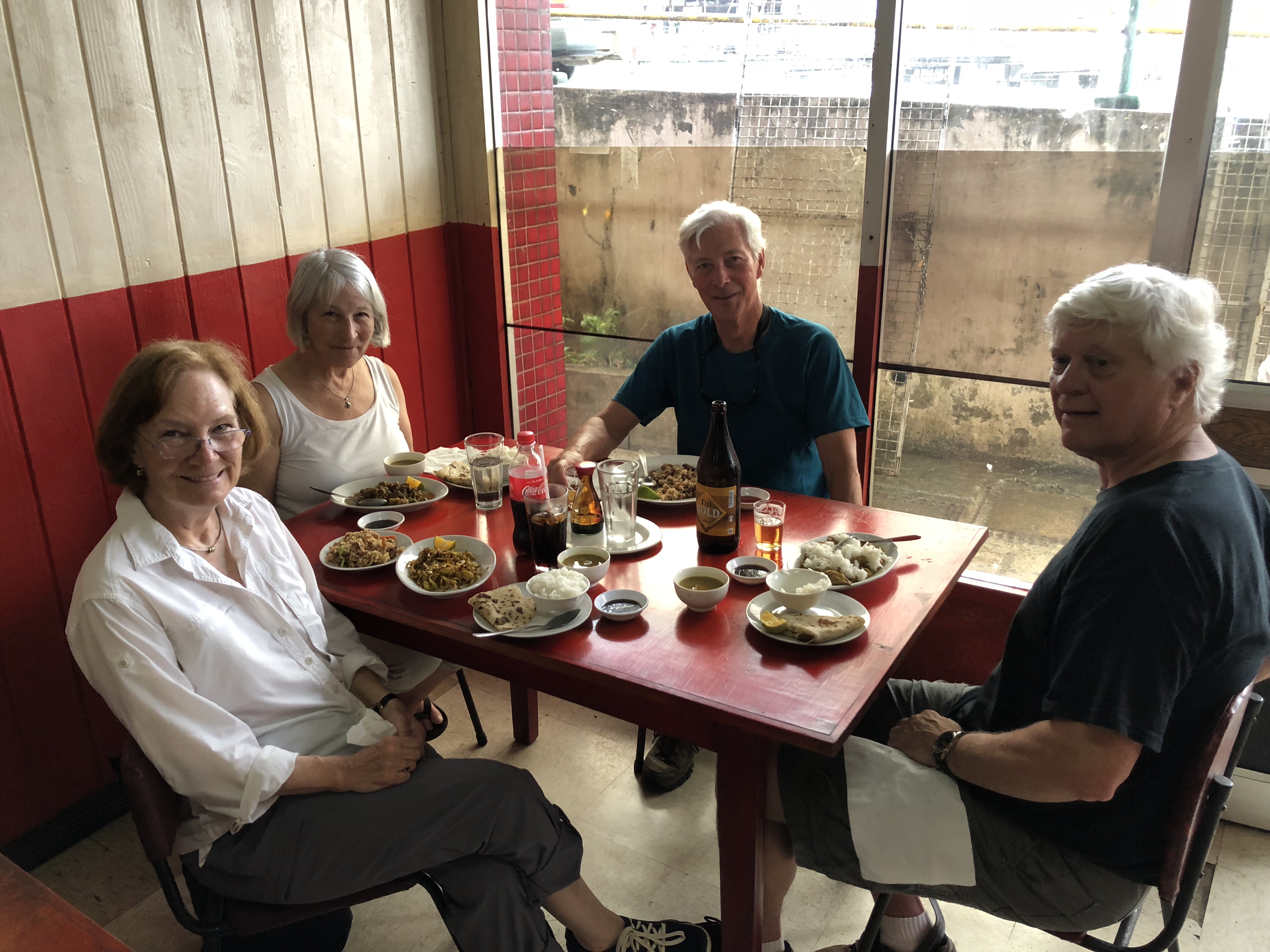
We drive back down the hill to the town and have a truly memorable and incredibly cheap Indian lunch served by the nicest woman with the most genuine smile. A Fijian the size of Wilt Chamberlain or William “the Refrigerator” Morris stops at our table and asks if we would like him to take pictures of us with our cameras. Of course.we do and he obliges as graciously as a good friend might.
We pay the negligible check and split for the longish drive to Suva, which is WAAAYYY more crowded, dense, developed and dirty than either Wayne or Cynthia remember (forty-three years later? Blink of an eye!). Our hotel, the Five Princes on the outskirts of the city, has a sign saying “Consulate der Nederlanden” and a picture of the Queen in the lobby. It also sports a wide veranda overlooking a forested valley that obscures the harbor, a lovely swimming pool and gracious rooms with the best showers we have had since we left our home in DC.
We mix some G&Ts and contemplate the past and present that is Suva so far. Then we drive through the dark city’s potholed streets and after some wrong turns and Google consultations, arrive at Seoul, a Korean restaurant on the sixth floor of a hotel.
We bump our way back to our hotel and crash.
Another day in Paradise.
 Two Tramps