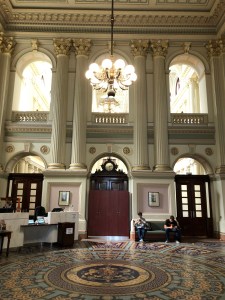
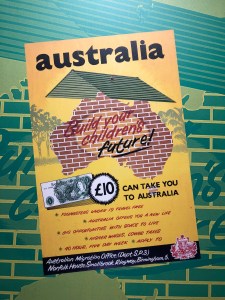
Treasury and Parliament buildings and the Immigration Museum
David runs down Bayview and turns left, toward the town beach where a dozen bathers of all ages, some in scuba gear, others in thongs, swim in the pre-dawn bay, and a lone woman sleeps on the long curve of sand that is so smooth and devoid of footprints that it looks manicured, as though it’s been dragged. As the sun rises, waiters set up tables outside a small café at one end of the beach.
We do some laundry and metro into the city to go to the Treasury building, which has exhibits on bushrangers, including Ned Kelly, history of the gold rush in the 1850s and ‘60s, and a copy of “The Welcome Stranger:” a single gold nugget found three centimeters under the soil in 1869, which weighs approximately 70 kilos. That’s quite some time before the Queen declared Australia’s six states a commonwealth in 1901 and the country’s new capitol was named Canberra in New South Wales — the choice being not Melbourne and not Sydney — in 1913. Melbourne likes to point out, however, that the current library room in its Parliament building served as the country’s legislature until it moved to Canberra in 1926. (Like Brazilia, building a nation’s capitol in the middle of nowhere takes time.)
We race from the Treasury building to Parliament to catch the 1:30 tour, which we discover has been cancelled, probably due to the reception and event being held to honor, in some way, the special relationship between Melbourne and Greece. We are told that we cannot even enter the building. But Cynthia says we want to have lunch in “The Stranger’s Corridor,” the restaurant for ministers that is open to the public when the Nibs are not in session and taking up all the seats. We are asked if we have reservations. We say we do not. Everyone looks very sad and apologetic and begins to mutter “not possible” under their breath. Cynthia says, “We were told we didn’t need to make them to eat there.”
“Right you are. Off you go then.” And we’re in. We get our badges on lanyards and are escorted through the main hall where Greeks in uniforms and Aussies in dark suits are shining up each other, and taken to the second-floor corridor. But now we’re unsure if the menu is suitable, so we go to the cafeteria on the third floor. Unescorted, by ourselves. We’re also not sure when the next tour is — 2 or 2:30 — so we go back, by ourselves, unescorted, through the very august atrium, and ask the reception desk when the next tour is and could we get lunch outside the building and return.
“Not advisable,” we’re told. The 2:30 tour is oversubscribed and to have any chance of joining it we must stay in the building and return to reception to replace our lanyards with tour badges. So, we end up eating a nice meal in splendid varnished wood and linen clothed surroundings and return to the reception rotunda for the tour.
The rotunda floor is quite something: made of a bazillion Minton tiles that form all manner of designs, its circumference, from the Book of Proverbs, says, “Where no counsel is the people fall but in the multitude of counselors there is safety” (sic … not a single comma mars that hope/admonition/agitprop/take your pick). The whole building — way moreso ornate and golden in the upper house than in the lower, no matter how much we are told this difference is not intentional — is stone and plaster outlined in 23-carat gold.
We leave Parliament and take in the “10 Pound Pom” exhibit at the Immigration Museum — basically a Brits-first, whites-only scheme to get more labor into Australia from 1945 to 1982 — which has capsule histories of about a dozen people and families, each with a different set of reasons for coming, staying, leaving, liking it, or hating it.
We get directions for a place to get some nice pastries to take home for dinner, have an ersatz Negroni and Aperol Spritzer, and take the train back to Jim and Jenny who serve up another really tasty meal and interesting conversation.
We need to leave tons of baggage behind because … because. David crashes and Cynthia packs her stuff for tomorrow’s trip of 10 days in Tasmania in a way guaranteed to leave behind several of her essentials.
Another politically enlightening day in Oz.
 Two Tramps